
Wonik Robotics Allegro Hand V5
In stock
- MARQUE:
- Wonik Robotics
- MODÈLE:
- Allegro Hand V5
- NUMÉRO DE PIÈCE #:
- Allegro Hand V5
- Warranty:
- 12 MOIS
- AVAILABILITY:
- SUBJECT TO AVAILABILITY
- SKU:
- Wonik-Allegro-Hand-V5
Wonik Robotics Allegro Hand V5
Overview
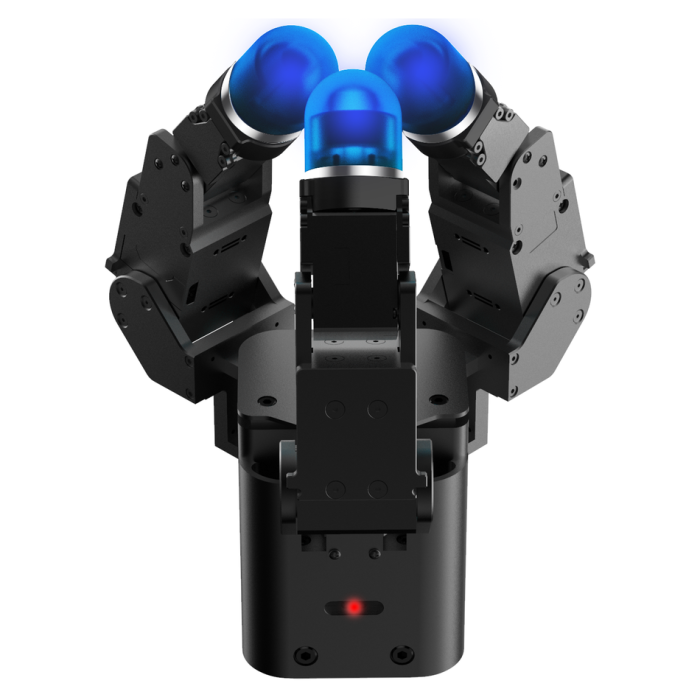
The Wonik Robotics Allegro Hand V5 is a dexterous robotic hand built around a simple and robust three-finger structure with nine active degrees of freedom. According to the manufacturer, its key components have been enhanced with recent technology, and each fingertip is equipped with a 360° omnidirectional pneumatic tactile sensor that detects pressure. The hand is positioned as a low-cost platform for dexterous manipulation, with applications described in both research and industry. The manufacturer lists multiple ready-to-use grasping algorithms stated to handle a variety of object geometries, and it supports real-time control and online simulation, which makes it relevant to laboratories and development teams working on manipulation, grasp planning, and tactile perception.
Watch the manufacturer product demonstration
Design and Mechanical Structure
The V5 uses a 9-DOF architecture composed of three fingers, each providing three active degrees of freedom. All nine joints are independent and current-controlled, driven by DC motors. The manufacturer lists a gear ratio of 288.35:1 for standard joints and 159.59:1 for the second joint of each finger, with corresponding stall torque values of 0.92 Nm and 1.6 Nm, and nominal torque values of 0.23 Nm and 0.48 Nm. Joint resolution is stated as 0.088 degrees, which supports fine positioning during grasp shaping and in-hand manipulation studies.
The complete hand weighs 1,050 g, and the manufacturer states a payload of 12 kg, depending on the measurement method. This qualifier matters: payload figures for multi-fingered hands vary significantly with grasp configuration and test procedure, so the stated value should be interpreted in the context of the manufacturer's own measurement approach rather than as a universal guarantee for every grasp type.
Verified Specifications
| Specification | Value |
|---|---|
| Number of fingers | 3 |
| Degrees of freedom | 3 fingers × 3 = 9 (active) |
| Actuation type | DC motor |
| Gear ratio | 288.35:1 / 159.59:1 (second joint of a finger) |
| Stall torque | 0.92 Nm / 1.6 Nm (second joint of a finger) |
| Nominal torque | 0.23 Nm / 0.48 Nm (second joint of a finger) |
| Payload | 12 kg (depending on the measurement method) |
| Weight | 1,050 g |
| Joint resolution | 0.088 deg |
| Communication type | CAN |
| Control frequency | 500 Hz (CAN) |
| Power requirement | 24.0 V / 5.0 A / 120 W |
Fingertip Tactile Sensing
A defining feature of the V5 is its fingertip sensing system. Each fingertip carries a 360° omnidirectional pressure-sensitive tactile sensor shaped like a finger, with stiffness described by the manufacturer as similar to a human finger. The sensor measures air pressure using a capacitive pressure sensing method, and the fingertip color changes based on tactile sensitivity. The manufacturer states that this sensing arrangement allows the hand to flexibly manipulate objects ranging from rigid items to deformable soft materials, and that applying omnidirectional tactile sensors to each fingertip opens up various types of research. It is worth noting that pressure measurement at the fingertip is a sensing capability; it should not be read as a direct statement of grasp force limits or of guaranteed outcomes with any particular object.
Fingertip Options
Wonik Robotics offers several fingertip types so users can match the sensor geometry to their application; these options are sold separately.
- Type A (Default): a standard attachment model with an internal structure that supports the external silicone surface, enabling a firm grip.
- Type B: the supporting structure for the silicone surface is positioned externally, making it suitable for delicate object gripping.
- Type C: the sensor length is reduced and measurement is restricted to the upper part of the sensor, allowing for a strong grip.
- Type D: a wide supporting structure installed on the back of the sensor enables a strong lateral grip.
Controls and Software
The hand communicates over CAN at a 500 Hz control frequency and requires a 24.0 V supply at 5.0 A (120 W). The nine joints are current-controlled, which gives developers direct influence over joint-level effort during grasping and manipulation. The manufacturer supplies Allegro Hand UXD, described as a comprehensive hand control system delivered through a visualized application. UXD provides real-time hand status monitoring, effortless hand pose generation, and versatile hand motion control via buttons. Combined with the listed support for real-time control and online simulation, this gives users both a graphical entry point for pose and motion work and lower-level access for custom controllers.
Research Context
The manufacturer positions this hand for dexterous manipulation research and industrial applications, with omnidirectional tactile sensing at each fingertip. The manufacturer's own application material for the V5 references grasping demonstrations with everyday objects such as snacks, an egg, and a banana, as well as a grasping solution that pairs vision AI with the tactile sensor and a tool changer for adaptive hand switching. The ready-to-use grasping algorithms and simulation support lower the barrier for teams that want to begin experiments without building a grasp stack from scratch, while the current-controlled joints and omnidirectional fingertip sensing give more advanced groups raw signals for their own perception and control research.
Integration Considerations
Before integrating the Allegro Hand V5 into a robot cell or research platform, several points are worth checking against your own requirements.
- Confirm that your host controller or interface hardware supports CAN communication at the hand's 500 Hz control frequency.
- Verify that your power infrastructure can deliver the stated 24.0 V / 5.0 A / 120 W requirement.
- Review how the 12 kg payload figure was measured and whether that measurement method reflects your intended grasp configurations.
- Check mechanical mounting compatibility with your robot arm or fixture, taking the 1,050 g hand weight into account for arm payload budgeting.
- Decide which fingertip type (A, B, C, or D) suits your objects and grasp styles, noting that fingertip options are sold separately.
- Evaluate whether the provided grasping algorithms and the UXD application cover your use case, or whether you will develop custom control on top of the current-controlled joints.
Frequently Asked Questions
How many fingers and degrees of freedom does the Allegro Hand V5 have?
The V5 has three fingers, each with three active degrees of freedom, for a total of nine active DOF. All nine joints are independent and current-controlled, driven by DC motors.
What kind of tactile sensing is built into the hand?
Each fingertip carries a 360° omnidirectional pressure-sensitive tactile sensor shaped like a finger. It measures air pressure with a capacitive pressure sensor, has stiffness described as similar to a human finger, and changes color based on tactile sensitivity.
Which fingertip options are available?
Four fingertip types are offered and sold separately: Type A (the default, with internal support for a firm grip), Type B (external support for delicate gripping), Type C (shortened sensor with upper-area measurement for a strong grip), and Type D (wide rear support for a strong lateral grip).
How does the hand communicate with a host system?
The hand uses CAN communication at a 500 Hz control frequency. Users should confirm that their control computer or interface hardware provides a compatible CAN connection before integration.
What software is provided for controlling the hand?
The manufacturer provides Allegro Hand UXD, a hand control system with a visualized application offering real-time status monitoring, pose generation, and button-based motion control. The hand also supports real-time control and online simulation, and the manufacturer lists multiple ready-to-use grasping algorithms.
What payload does the manufacturer state for the V5?
The stated payload is 12 kg, depending on the measurement method. Because payload results for multi-fingered hands vary with grasp configuration and test procedure, this figure should be checked against the measurement conditions relevant to your application.
Summary
The Wonik Robotics Allegro Hand V5 combines a robust three-finger, nine-DOF structure with independent current-controlled joints, 360° omnidirectional pneumatic fingertip tactile sensors, and a choice of four fingertip types. With CAN communication at 500 Hz, a stated 12 kg payload depending on the measurement method, a 1,050 g weight, and the UXD visualized control application alongside ready-to-use grasping algorithms and simulation support, it is aimed at research groups and industrial developers who need an accessible platform for dexterous manipulation and tactile sensing work.
Request a quotation to confirm configuration, pricing and availability. Catalog stock status is not confirmation of physical inventory or immediate shipment.